

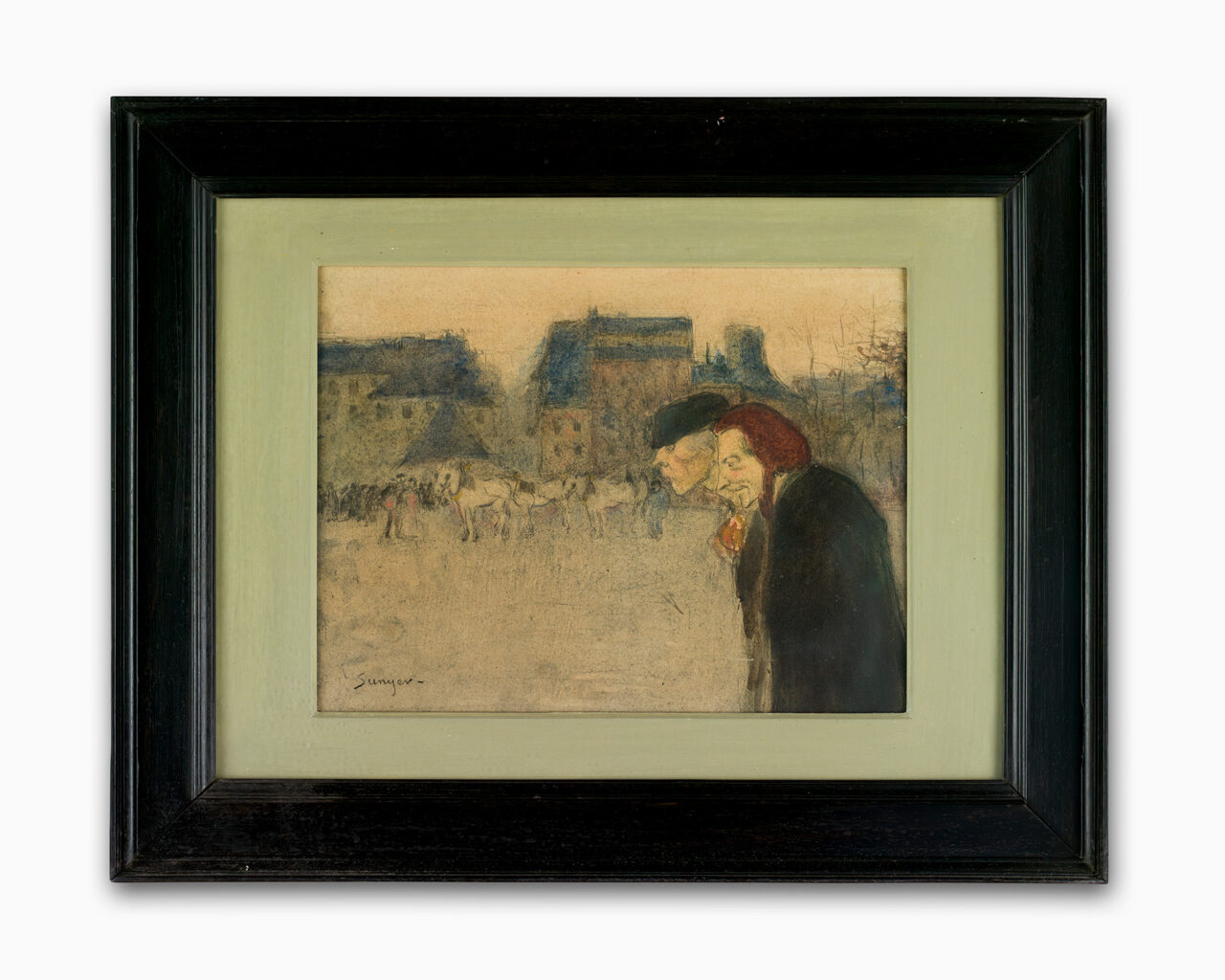
Joaquim Sunyer’s dedication to painting has led some of his works to be regarded as veritable manifestos of the Noucentisme movement, contributing to a narrow perception of his place within it. Yet his career and work are far richer and more diverse, including influences from Naturalism and Impressionism imported from France, as well as Symbolism and the effects of Cubism evident in many of his works.
Sunyer settled in Paris in 1896, where he experienced real social exclusion. The present work on paper is representative of those years, when, influenced by Symbolism, he depicted the streets and markets of Montmartre. Here, he portrays a group of beggars on Rue Lepic, the street that leads to the famed Moulin de la Galette.
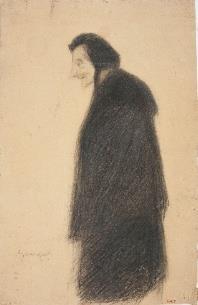
The female figure in this group is the same woman depicted, on her own, in Vella vestida de negre (Old Woman Dressed in Black; 31 × 20.1 cm), preserved in the Museu Nacional d’Art de Catalunya (inv. no. 039129-D).
In the French capital, Sunyer reconnected with Isidre Nonell, his former classmate at the Escola de la Llotja in Barcelona, and a fellow member of La Colla del Safrà. Both shared a desire for modernity and a determination to break free from academic conventions—an ambition reflected in their technical experimentation.
In this respect, Les clochards (The Beggars). Montmartre or Rue Lepic is executed in ink and watercolour, with a final layer of sprayed ink and resin applied to the paper. This highly unusual technique strongly suggests Nonell’s influence, as he was then producing his celebrated dibujos fritos (“fried drawings”): paper compositions coated with resin to create an enamel-like surface, even though no heat was actually involved in the process. Although Les clochards (The Beggars). Montmartre or Rue Lepic does not seek to reproduce the distinctive appearance of Nonell’s fritos, it reveals the same drive for innovation and technical experimentation.