

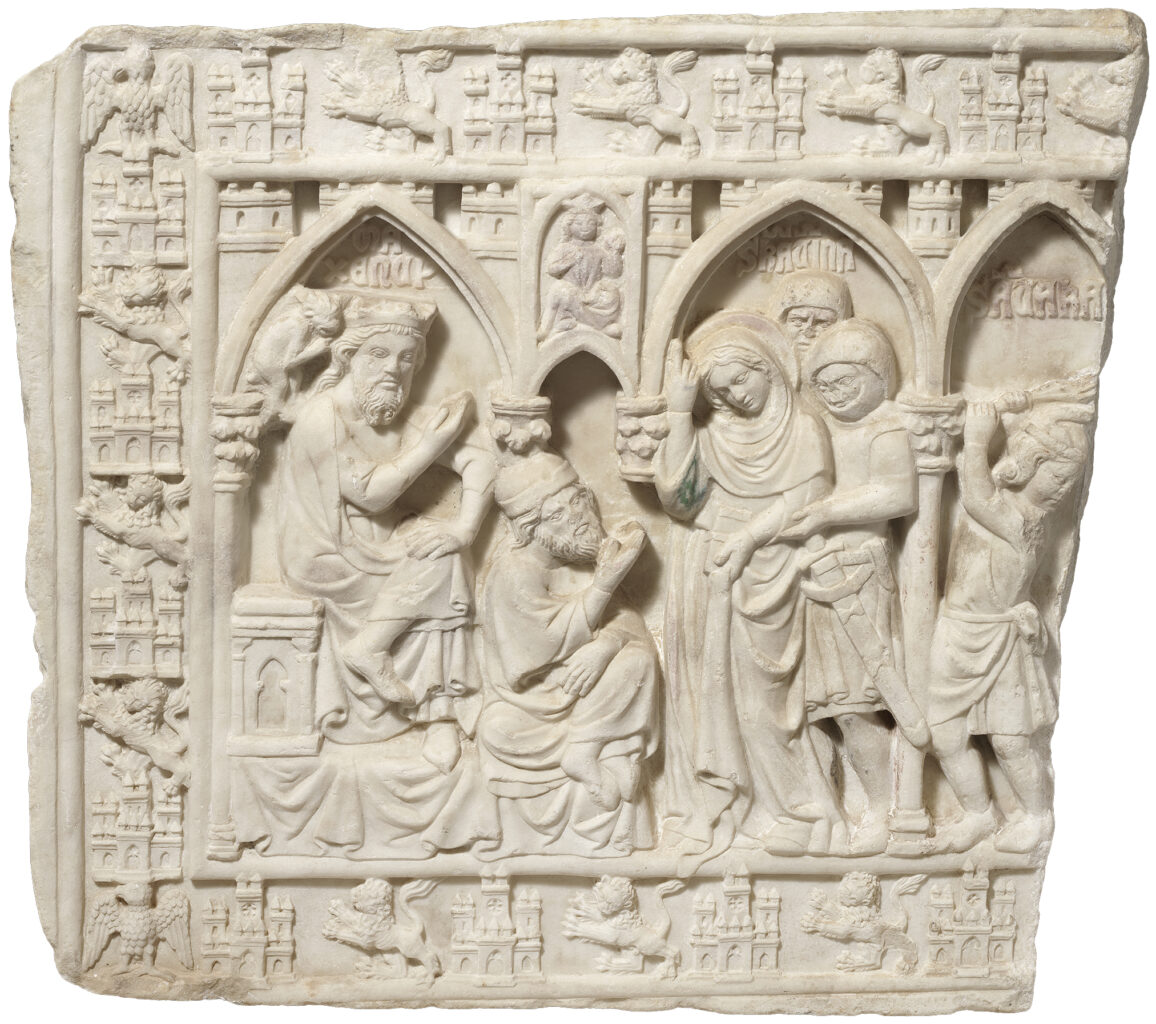
This fragment of a white marble relief depicts, with remarkable subtlety, scenes from Saint Catherine’s dispute, condemnation, and martyrdom, framed by a heraldic band associated with the reign of Alfonso X.
On this basis, Professor Gerardo Boto Varela has conducted rigorous research concluding that the relief was commissioned during the third quarter of the 13th century by Alfonso X the Wise to decorate the tomb of his mother, Queen Beatrice of Swabia. The heraldic band surrounding the marble combines the arms of Castile and León, while the corners feature spread-winged eagles associated with the imperial Hohenstaufen dynasty. The only context in which these heraldic motifs have been used in relation to the cult of Saint Catherine is the monastery of Las Huelgas (Burgos). According to written evidence brought to light by this study, the queen was buried beneath the altar of Saint Catherine in the church of the Cistercian monastery. The marble fragment dedicated to the saint is therefore identified as the altarpiece that decorated the north aisle of the church, also giving its name to it. By placing it in the context of the church of the Abbey of Santa María la Real de Las Huelgas, a reconstruction of the location and ceremonial setting of Queen Beatrice’s first burial is proposed.
Boto Varela, Gerardo. “El primer retablo hispano de Santa Catalina y la presencia sepulcral de Beatriz de Suabia en Las Huelgas», Anuario de Estudios Medievales 54 (2), julio-diciembre 2024, 1380.