

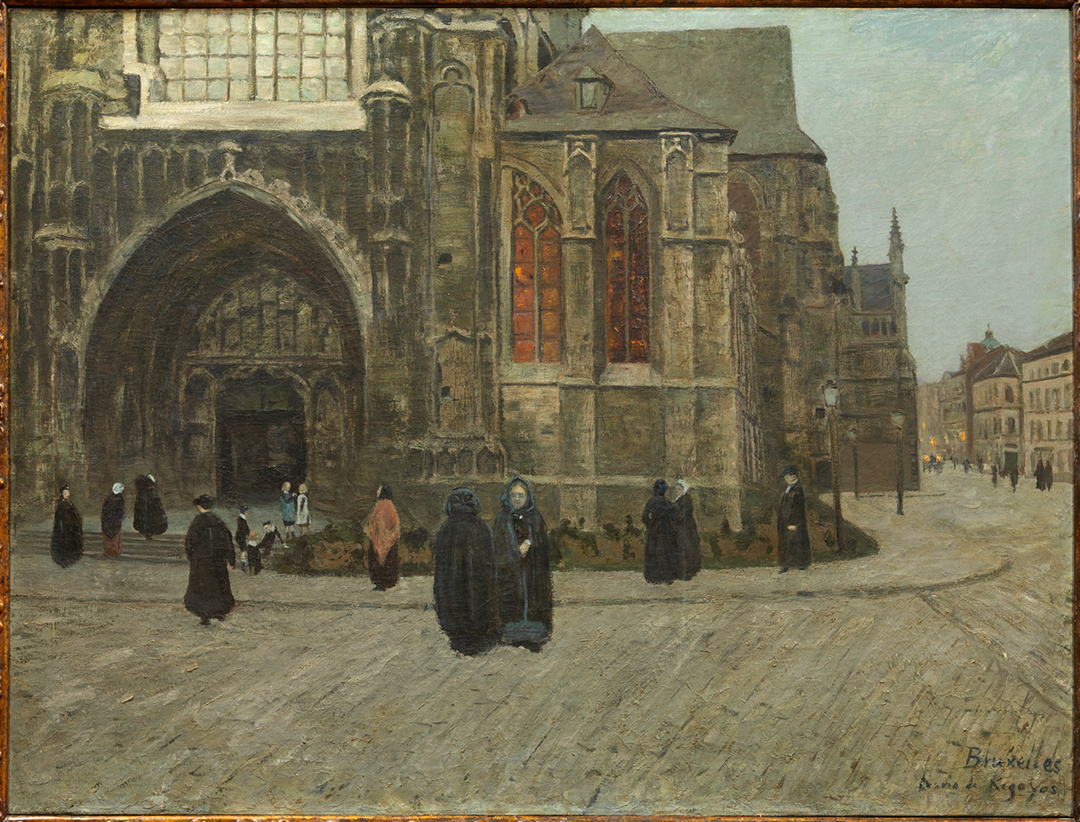
Darío de Regoyos was a key figure in connecting Spanish painting with the French and Belgian avant-garde. The publication of España negra (Black Spain, 1899), including texts by Émile Verhaeren, marked the culmination of his expressionist period, characterised by a profound fascination with the tragic and the elemental, and a turn towards an impressionist language which centred on the elements of air and light.
Regoyos maintained close ties with the Catalan artists associated with Els Quatre Gats, with whom he shared a commitment to artistic modernity. During his long stay in Brussels, where he became involved with some of the most progressive artistic circles of the time, he painted El Mes de María (Month of Mary) in 1884 and included it in an exhibition at the Belgian National Salon. A decade later, after returning to Spain, he submitted it to the Second General Exhibition of Fine Arts in Barcelona (Segunda Exposición General de Bellas Artes) and received an award as a result. When the jury declined to acquire the work for the city’s Museum of Fine Arts, a group of artists and intellectuals, led by the multifaceted Josep Pascó and the art critic Raimon Casellas, launched a fundraising campaign to buy it and donate it. The museum, however, refused the gift, unwilling to contradict the jury’s decision.
A few years later, Regoyos was the subject of a retrospective exhibition at Els Quatre Gats, conceived as a vindication of his work in keeping with the establishment’s independent spirit. El Mes de María was given a place of honour in the exhibition. The more specialised press used the opportunity not only to praise the painting but also to criticise the lack of vision of the museum that had rejected it.
“This painting is the centrepiece of the small exhibition organised at Els Quatre Gats. For those familiar with the cathedrals of Rouen painted by Monet, it is evident that, while preserving his own artistic personality, Regoyos can stand comparison with the French master. For everyone—or at least for those who know how to look—it is a magnificent work of painting: restrained, precise, balanced, and, in one word, excellent.”
Miquel Utrillo, Luz, no. 8, 1898.
Miquel Utrillo, Luz, núm. 8, 1898.