

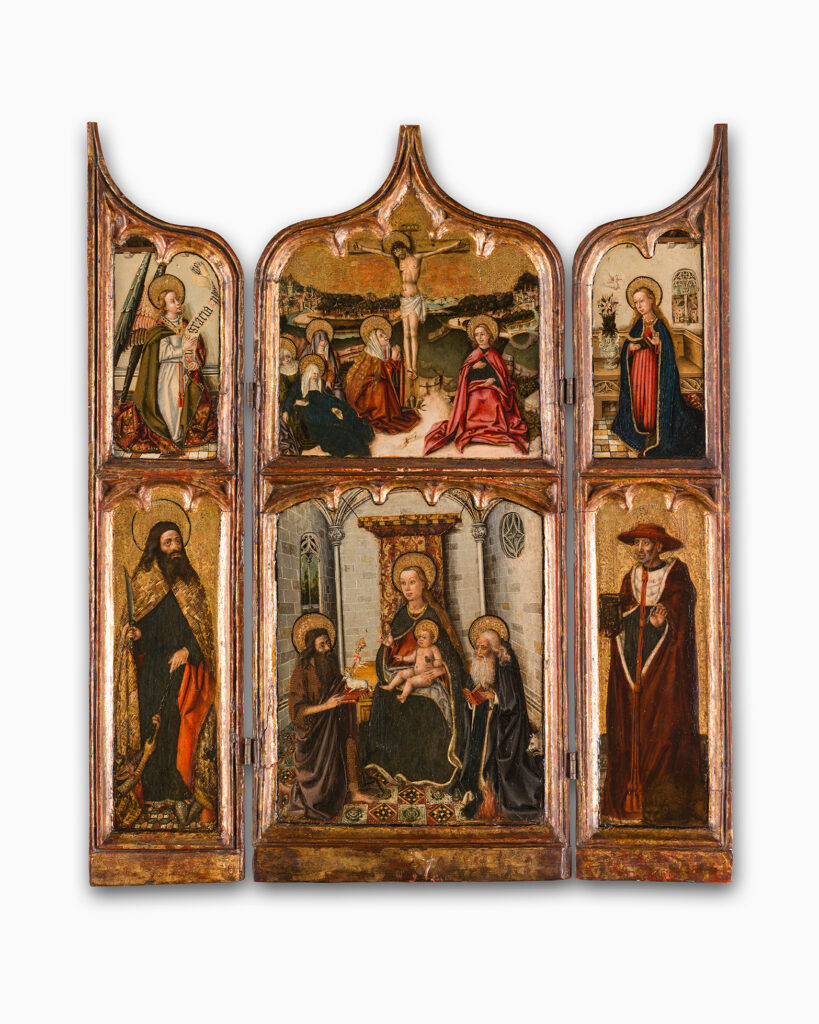
Together with Jacomart, Joan Reixach was a key figure in the introduction of Flemish models into Valencian painting. Created for private devotion, this small triptych has survived exceptionally intact.
The central panel and the wings are framed by mouldings with pointed outlines. Each panel is divided into two compartments crowned by small arches. The triptych’s modest dimensions and compartmentalised composition required the scenes to be executed on a remarkably small scale, with details rendered in the manner of true miniatures. Furthermore, the chromatic palette used in the backgrounds creates an alternating play of colours that lends an exquisite balance to the overall composition.
The present work was first published by José Gómez Frechina, who attributed it to Joan Reixach and dated it to a period prior to the Triptych of the Virgin and Child with Saint Michael and Saint Jerome, now in the Städelsches Kunstinstitut, Frankfurt am Main.
“This work is divided into two compartments. The lower register depicts the Virgin and Child flanked by Saint John the Baptist and Saint Anthony Abbot on the central panel, and Saint Bartholomew and Saint Jerome on the side wings. The upper register shows the Crucifixion in the centre and the Annunciation on the two wings. The model of the Crucified Christ in the Crucifixion corresponds to Reixach’s characteristic style, while the panoramic landscape with its towns, roads, bridges and small figures appears to have been depicted in a manner similar to that found in other works by the painter.”
Gómez Frechina, José. “Triptych of the Virgin and Child. Joan Reixach (active between 1431 and 1486),” in F. Benito Doménech and J. Gómez Frechina, La Clave Flamenca en los Primitivos Valencianos, Valencia, 2001, p. 220.
Indeed, the similarities between the two triptychs are numerous. Beyond their formal affinities, they share a range of stylistic features, including the depiction of Saint Jerome dressed as a cardinal and the close resemblance between the face of the guardian angel in this work and that of the Angel of the Annunciation in the Frankfurt triptych.
The format of this work is unusual within the Valencian tradition. It is a clear example of the Flemish influence that reached Valencia as a result of the city’s close artistic and commercial ties with the major centres of Flanders, evidenced also by the trips and encounters between artists from both regions.