

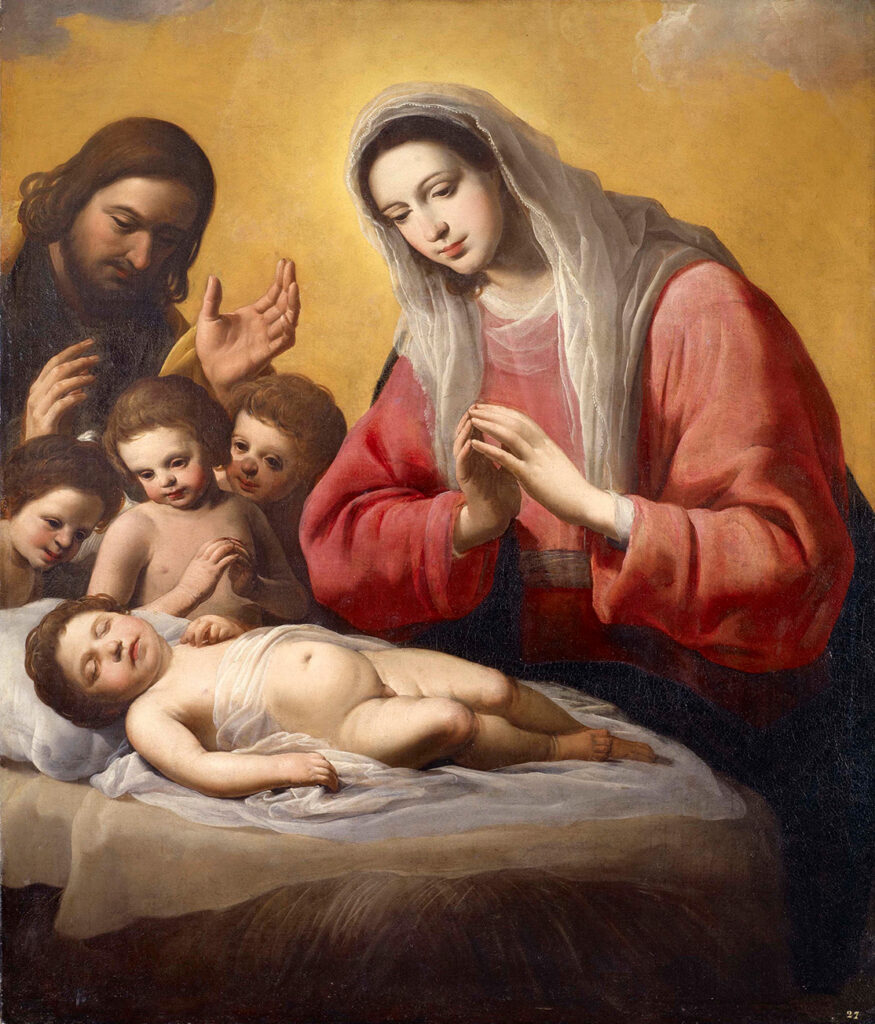
Eugenio Cajés was one of the most notable Spanish painters trained in Italy and active at the royal court during the first half of the 17th century. He succeeded his father, Patricio Cajés, as Painter to the King and, from an early stage in his career, collaborated with Vicente Carducho on several major commissions, including projects for Toledo Cathedral, the Convent of Santo Domingo el Real in Madrid, and the Monastery of Guadalupe.
The present composition is representative of the artist’s preferred subjects as well as of his mature style, developed at the intersection of the Escorial Mannerist tradition and the emerging naturalism of the early seventeenth century. The figures in his works have a robust monumentality, while retaining a remarkable delicacy through their soft, rounded contours that reflect the influence of Correggio.
“The theme of the Virgin and Child, in its various forms, was one of the subjects most frequently commissioned to Cajés, who produced numerous versions, all with the underlying presence of the drawing from the Museo del Prado. Executed swiftly and economically, this sheet studies several positions for the Virgin’s head. Another drawing in the Courtauld Institute in London displays greater painting qualities, is more resolved and also squared. In relation to these drawings, several unpublished or little-known paintings may be identified. While the Courtauld drawing of the Virgin and Child can clearly be associated with the more elaborate composition The Virgin and Child with Angels in the Museo del Prado, it bears an even more direct relationship to The Holy Family with Angels in Prayer in the Casacuberta Marsans Collection, becoming without doubt its closest precedent.”
Pascual Chenel, Álvaro. “Drawing, Speculating, and Drawing Again: The Carduchos and Cajés between Italian Training and the Spanish School”, in Boletín de Arte, 2009, no. 40, pp. 281–293.
Pascual Chenel, Álvaro. (2019). «Dibujar, especular y más dibujar. Los Carducho y Cajés, entre la formación italiana y la escuela española». Boletín De Arte, núm.40, pp. 281–293.