

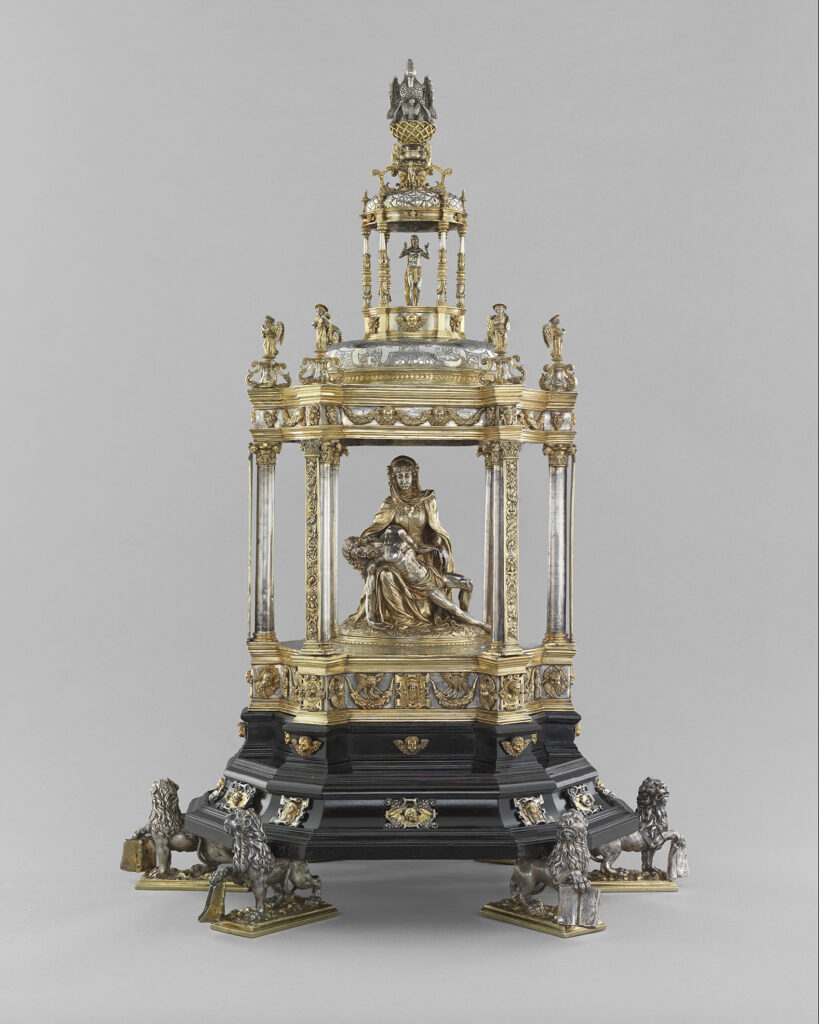
The Eucharistic monstrance in the Casacuberta Marsans Collection is an outstanding example of sixteenth-century Zaragoza silverwork. Unpublished until recent years, the piece is distinguished by its complex material history, the result of successive phases of manufacture and alteration identifiable through the study of its hallmarks, structure, and decorative vocabulary. Its composite character makes it a particularly valuable witness to the development of Aragonese goldsmithing between the Plateresque style and the late Renaissance.
The monstrance is richly ornamented with grotesque decoration extending across both its architectural framework and cast appliqués, fully reflecting the ornamental repertories disseminated in Iberian metalwork during the sixteenth century. The object also reveals two distinct phases of production: a lower section executed around the mid-sixteenth century and a later lantern stage, whose addition modified and enriched the original appearance of the piece.
Research undertaken by Lourdes de Sanjosé has emphasised the coexistence of Eucharistic and devotional meanings within the work. The figure of Christ the Redeemer and the pelican feeding its young at the summit of the monstrance evoke Eucharistic symbolism, while the prominent inclusion of a Pietà introduces a complementary devotional dimension. The absence of the luna and the secondary nature of certain components suggest that the object may have been adapted to different liturgical functions throughout its history. This dual purpose helps explain its present configuration and its exceptional significance within 16th-century Aragonese silverwork.