

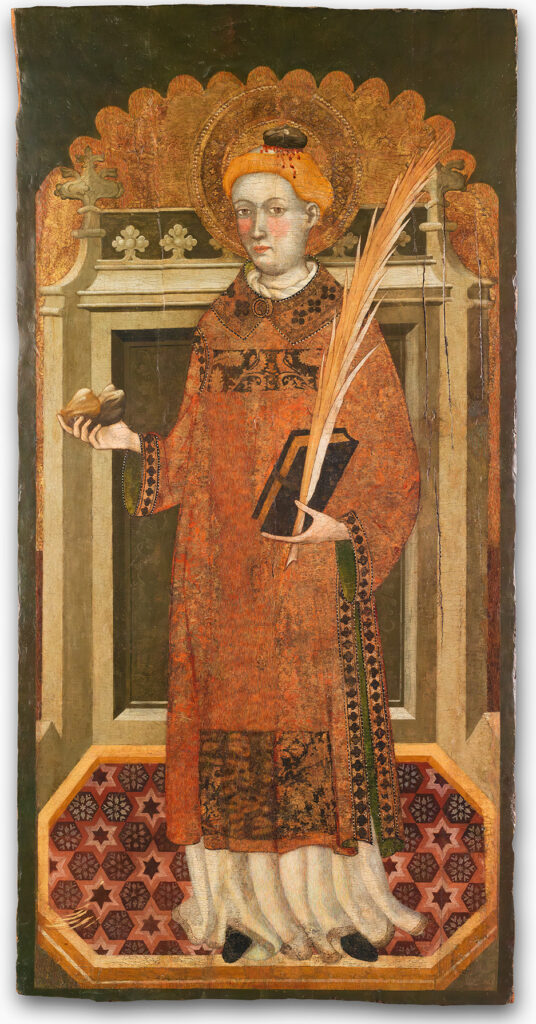
This panel depicting Saint Stephen, the protomartyr, spent nearly two centuries being reused as the door of a farmhouse in the Vallirana-Cervelló area. Such secular repurposing resulted in the loss of some structural elements and portions of the original paint layer. Remarkably, however, this secondary use also preserved the work from later restorations and interventions, an exceptional circumstance for a panel of this date.
Following its rediscovery in 2011, art historian Jaume Barrachina attributed the painting to Lluís Borrassà “without any scientific or legal reservations.” The Girona-born painter is widely regarded as the introducer of the International Gothic style in Catalonia. Established in Barcelona from the closing years of the 14th century, his workshop was the most important of the period, with more than fifty documented altarpiece commissions.
The saint is represented standing, vested as a deacon in a dalmatic and enthroned within an architectural setting atop an octagonal platform of Moorish inspiration. He holds his traditional attributes: in his left hand, a book and the martyr’s palm; in his right, two stones, while a third rests upon his head, alluding to his martyrdom. Conservation treatment revealed the incised outlines of an earlier palm branch painted on the pavement below, oriented downward. Although fully executed, this motif is without parallel in 15 th-century Catalan painting. It appears that Borrassà himself rejected the solution, concealing it beneath paint and replacing it with the final, upward-pointing palm.
The construction of the reverse of the panel has enabled scholars to associate it with a Calvary by the same artist, now in a private collection, which would have formed the adjoining scene within the original altarpiece. Together, the works have been linked to a retable commissioned from Lluís Borrassà for the church of Sant Esteve de Palautordera in August 1423, whose documentary description closely matches this composition.