

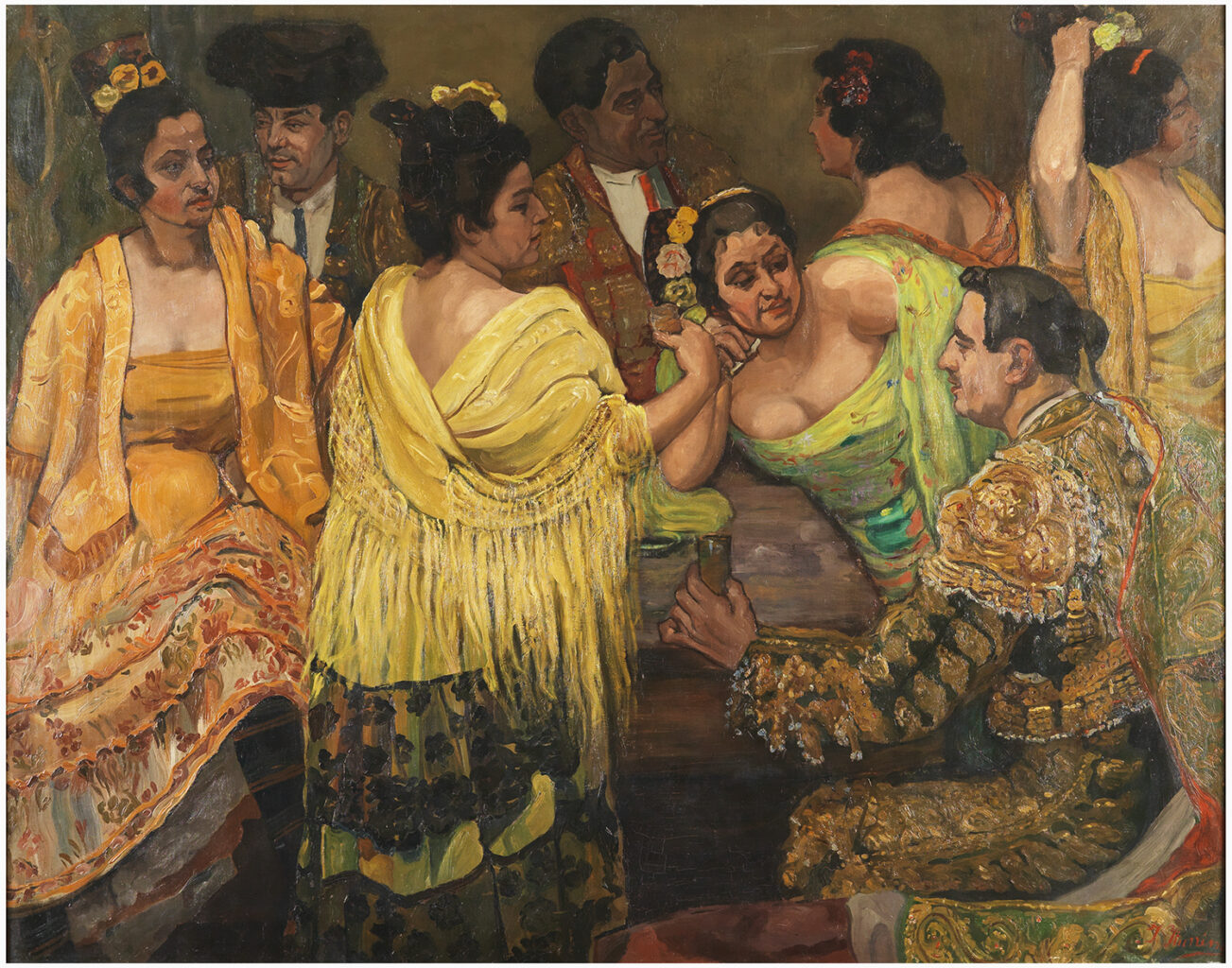
Bullfighters and Manolas belongs to the mature phase of Francisco Iturrino’s career, developed during the years in which the artist frequently travelled through Andalusia and found inspiration in its festivities and social life. Here, popular costumbrista subject matter becomes a field of formal experimentation in which colour, light, and movement assume a leading role. On stylistic and thematic grounds, the painting can be dated to around 1910-1915, a period corresponding to the height of the artist’s creative activity and his closest engagement with Fauvist principles.
The composition brings together a group of bullfighters and women dressed in embroidered shawls and flowers around a table. The figures occupy almost the entire pictorial surface, a strategy that heightens the sense of immediacy and proximity. Rather than constructing a deeply recessionary space, Iturrino concentrates attention on the interaction of the figures, the rhythm of their silhouettes, the expressiveness of their gestures and, above all, the power of colour.
Yellows, greens, oranges and golds dominate the composition, modelling forms through broad, visibly applied brushstrokes. The embroidery of the trajes de luces, the fringes of the shawls and the flowers adorning the women’s hair unfold in a vibrant chromatic display. This decorative and luminous treatment aligns the painting with Iturrino’s dialogue with the early French avant-garde and helps explain his recognition as one of the principal exponents of Fauvism in Spain.
Beyond its bullfighting imagery, Bullfighters and Manolas is a celebration of the vitality and sensuality of modern life. As in many of Iturrino’s works from this period, the artist’s aim is not to narrate a specific event but to evoke an intense and dynamic atmosphere through the expressive force of colour and the monumental presence of the figures, transformed into vehicles of pictorial modernity.