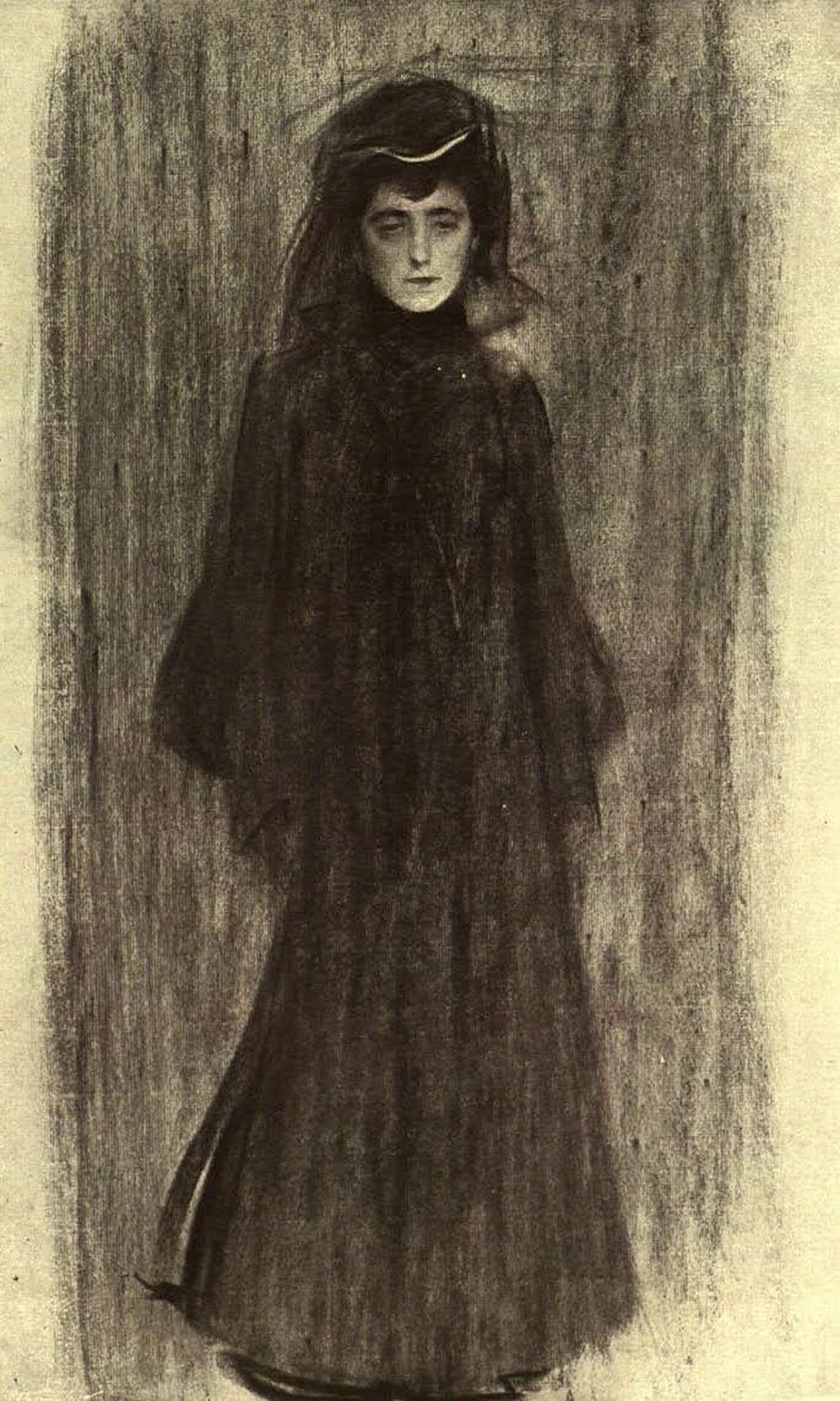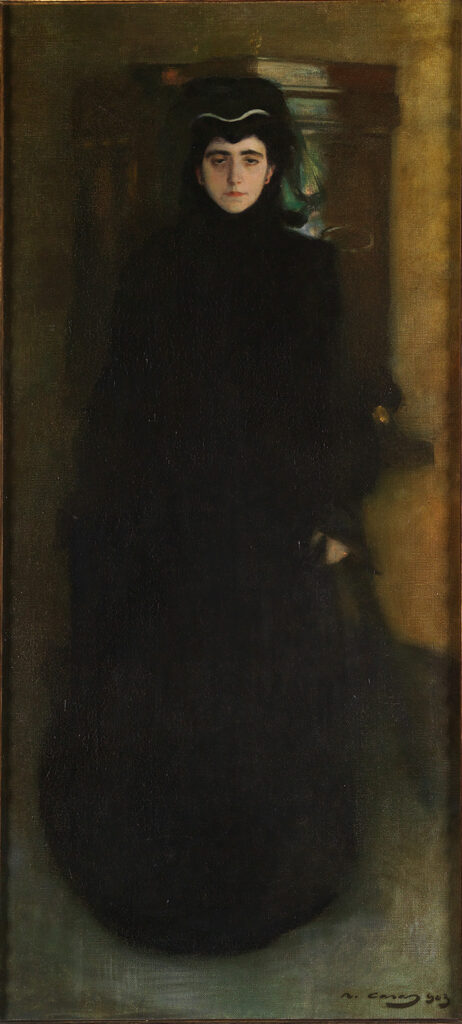
The painter Ramon Casas i Carbó, one of the leading figures of Catalan Modernisme, often portrayed his sisters, Montserrat and Elisa, in full-length portraits and in scenes of everyday life.
This large oil portrait, almost life-size, depicts Elisa Casas i Carbó (1872–1960) in mourning following the death of her husband, Josep Codina i Prat. Like her brother, Elisa was also an artist: a poet, actress and pianist. Between 1897 and 1908, she published forty-five texts—both poetry and prose—in the magazine El Eco de Sitges.
Preserved in the private collection of the Codina family is the preparatory drawing for the present painting. Both works were published in the journal Forma in 1904, the same year in which Casas exhibited the painting in the show organised in his studio together with sculptor Miquel Blay.
Casas first portrayed his sister when she was barely out of adolescence, and painted her again after she married, standing and holding her fur stole in a gesture that seems intended to draw attention to her wedding ring, affirming her status as a wife. In the portrait now in the Casacuberta Marsans Collection, she appears as a widow, entirely dressed in black. The emotional intensity is concentrated in her face, but also in the glint of the ring she is still wearing on her finger. However, this painting was not created simply to illustrate a social status; rather, it is a posthumous portrait, exploring the idea of death in life—an exceptionally radical conception that makes it one of Ramon Casas’s most symbolist works. Aware of its significance, the artist chose to exhibit it at the Nineteenth Exhibition of the Vienna Secession, held between January and March 1904.