

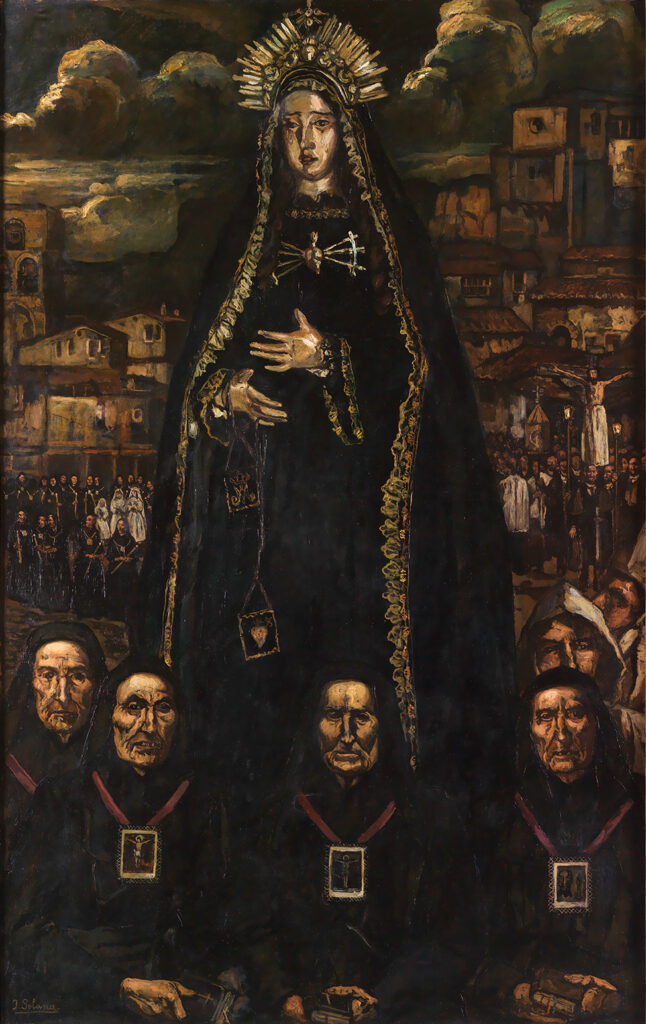
Within the context of the Generation of ‘98, Generation of ‘14, and Generation of ’27, José Gutiérrez Solana was one of the central figures of the literary and artistic gatherings held at Madrid’s Café de Pombo. His literary work is as significant as his paintings. Solana was very critical of Spanish society, in which he saw no possibility of renewal. His entire body of work portrays a Spain incapable of modernisation, and “La Dolorosa” (Our Lady of Sorrows) stands as a powerful metaphor for this.
This painting belonged to the collection of the distinguished Chilean art critic Alfredo Velarde (Valparaíso, 1898 – Viña del Mar, 1983). A collector and friend of the artist, Velarde assembled an exceptional collection of Solana’s works during his years in Spain between 1920 and 1937. He greatly admired the painter, saying that “he was not a fashionable artist, and for that very reason he would never go out of fashion.” Velarde believed that Solana’s painting was not for the faint-hearted, for it was created, in the words of the writer Ramón Gómez de la Serna, “with the black colour of life.”
Catalogue of the Solana Velarde exhibition at the Iñigo Navarro gallery (2025).