

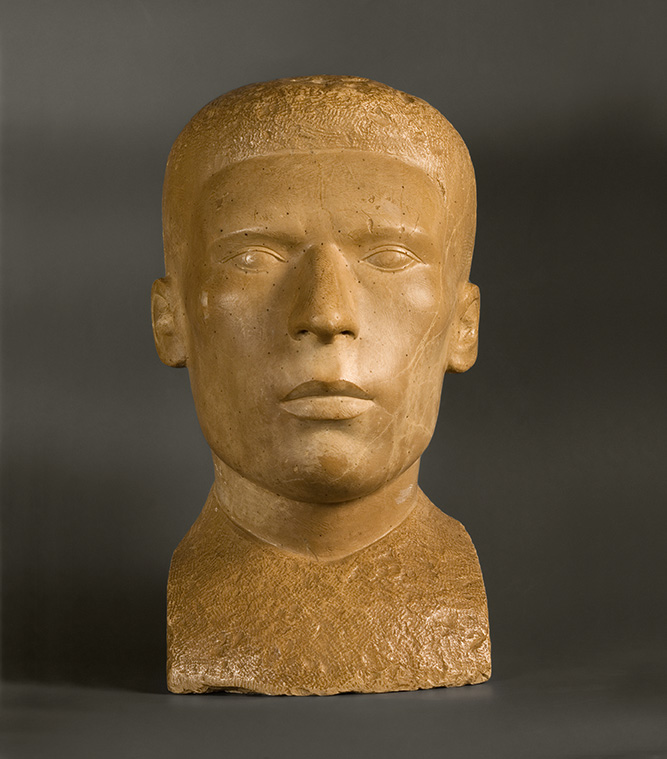
“It was in the 1920s, when Joan Rebull was virtually confined to the mysterious studio-workshop on Laforja Street (…), deprived of even the most basic comforts and urgently lacking the means of subsistence, that Rebull was forced to use himself as his own model, studying his face in the mirror and feeling the contours of his body with hands gifted with tactile memory.”
Corredor Matheos, José; Mercadé, Albert. Joan Rebull. Catálogo razonado de esculturas, Barcelona, Fundación Arte y Mecenazgo, 2010, p. 96.
In these words, Joan Merli, a friend and patron of Joan Rebull, gives insight into the context in which the artist’s well-known stone self-portraits were created. Throughout this period, spanning from 1918 to 1926, Rebull laid the foundations of his sculptural language, deeply rooted in the Archaic and Egyptian traditions and marked by a strong interest in compact volumes, pure forms and synthetic realism.
Partly the result of a practical necessity—the lack of resources to hire models for his sculptures—the present Self-portrait is a key work in the development of Rebull’s artistic identity, embodying the synthetic volumes and forms so characteristic of his work, as well as the use of limestone, a material he would employ frequently throughout his career.