

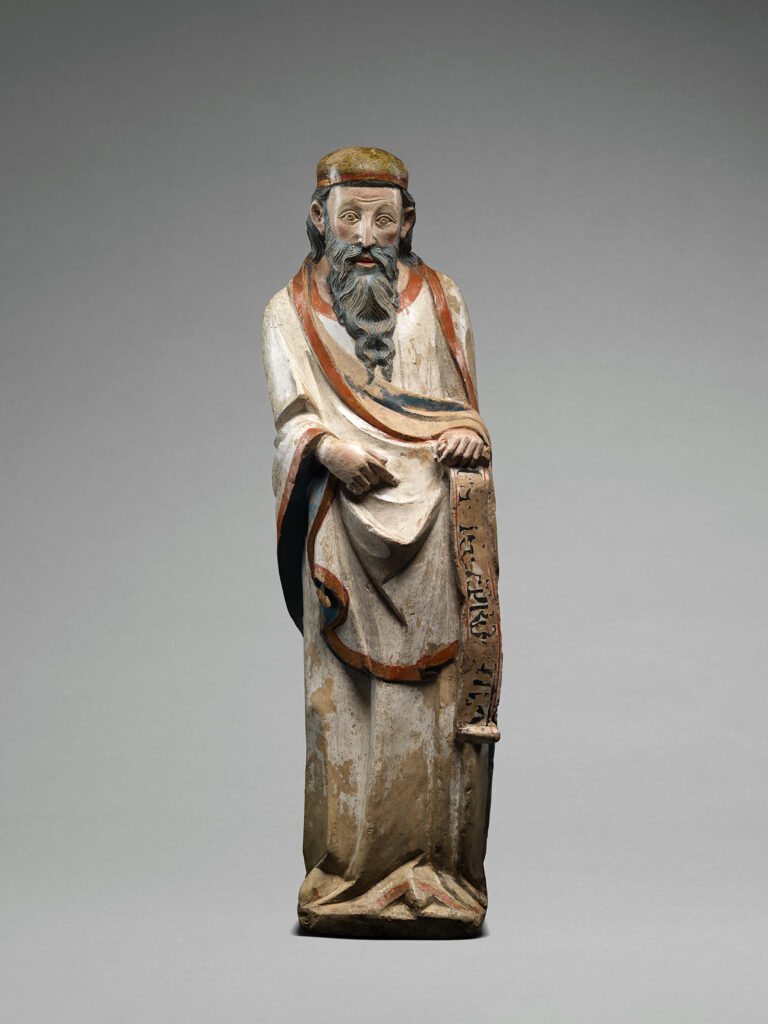
This limestone sculpture has been attributed by Antoni Pitarch to Jaume Cascalls and his workshop. A leading representative of the Catalan school of Gothic sculpture, Cascalls was closely associated with the commissions from Peter IV of Aragon, known as the Ceremonious, for the royal tombs at Poblet.
Pitarch argues that, although the scale of the sculpture might initially suggest a devotional function, this is unlikely, as the prophet Daniel was not represented as an isolated figure at that time. Instead, it should be understood as an element placed within a Gothic portal featuring an iconographic programme centred on the theme of Redemption. In this context, figures from the Old Testament who foretold Christ’s coming were juxtaposed with those from the New Testament who fulfilled those prophecies.
The identification of the figure as the prophet, the work’s size and its stylistic features strongly suggest that it was originally intended for a Gothic portal in New Catalonia (Catalunya Nova). The artist represented the eyes by drilling the pupils —an unusual technique —, and, demonstrating careful attention to iconographic detail, gave the figure long hair and a distinctly Jewish profile, emphasising both his origin and his cultural identity.