

A leading figure of the second generation of Catalan Modernisme, Joaquim Mir managed to embody some of the most progressive artistic ideas of his time, developing an innovative approach to landscape that positioned him firmly within European modernity. His artistic quest began by transforming reality through light and reached its highest expression in his works from Mallorca, where form dissolves into colour. The creative intensity he experienced throughout this period led to his admission to a psychiatric institution, followed by his recovery in the nearby village of L’Aleixar. There, he continued the artistic experimentation he had initiated in Mallorca and produced some of the most significant landscapes of his entire career.
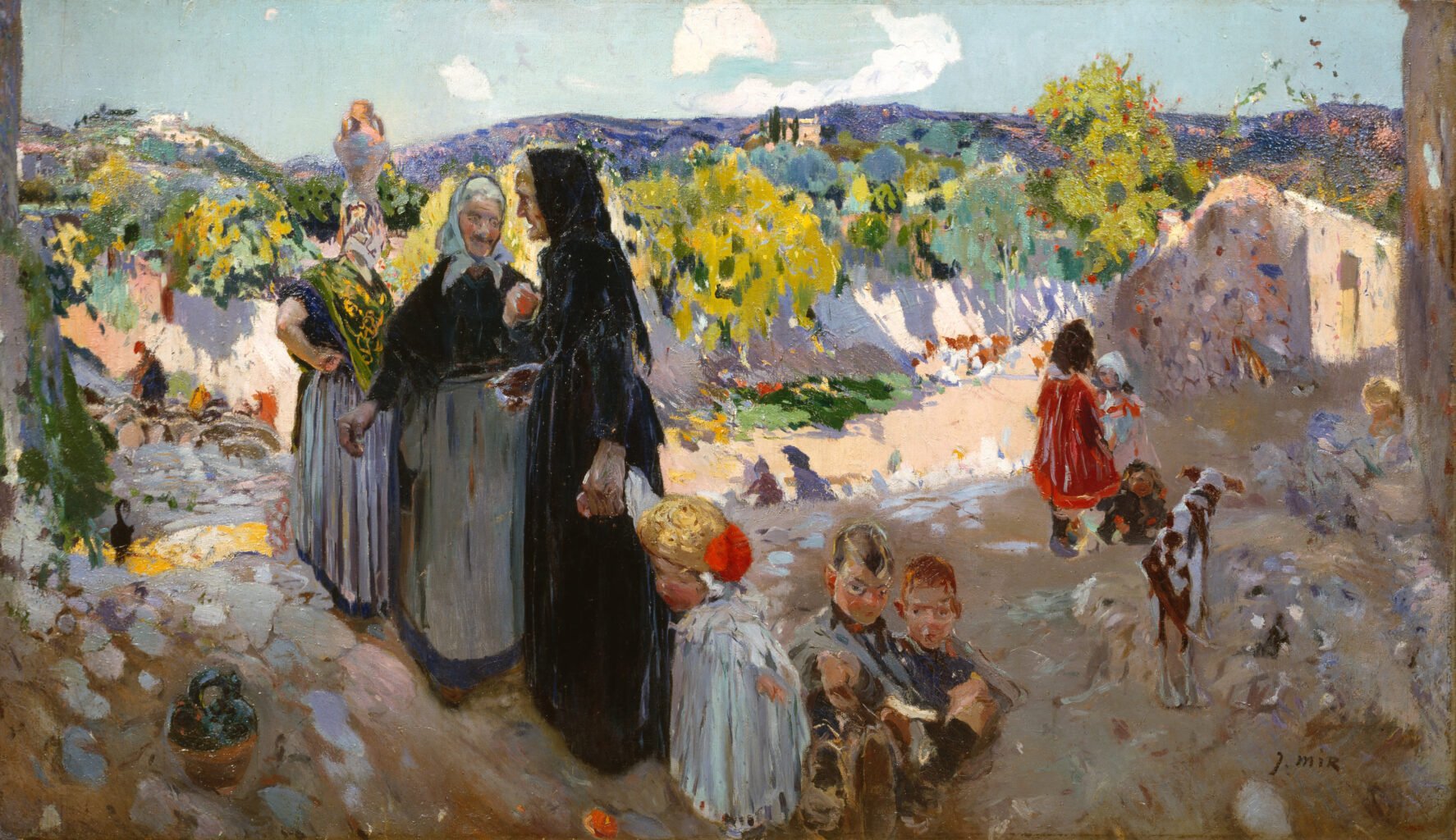
Among the few figurative works painted during this period is El xerroteig, about which Alexandre de Riquer wrote:
According to Francesc Miralles, El xerroteig, together with Les velles, Els cantaires and El Vell petaca, “forms an extraordinary ensemble of figurative paintings, free from the excesses of the ‘Black Spain’ tradition yet equally, if not more, representative. In these works, only the explosion of colour—reflecting the artist’s exuberant state of mind—softens the power of figures that deserve to be included in any anthology of the finest Expressionism.”
Francesc Miralles, Joaquim Mir, 1873–1940, Fundación MAPFRE, Madrid, 2004, p. 108.
“El xerroteig is one of those canvases that only Mir could have produced. It is among his most genuinely personal works, embodying all the many qualities of his art. The mountains in the background, with its mauve and violet tones, the indulgent variety of greens, and the radiant brilliance of our golden sun. The foreground with its reflecting figures bathing in the half-light of the luminous atmosphere that envelops them, the old women, the dogs, the children, the shepherd, all are imbued with the intense vitality bestowed upon them by this passionate artist, whom some dismiss as unbalanced…”
Alexandre de Riquer, “Joaquín Mir,” Mediterrània, no. 6, Barcelona, 4 April 1915.