

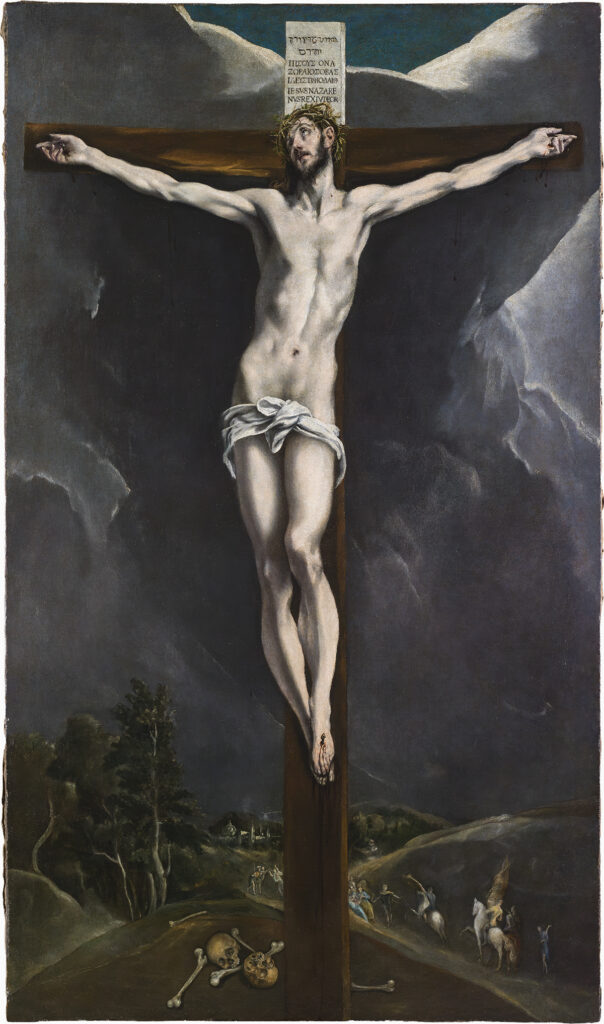
This Christ on the Cross is considered the earliest version of this subject painted by El Greco. Its closest iconographic precedent is Crucifixion with Two Donors (Paris, Musée du Louvre), which came from the Convent of La Reina in Toledo. Unlike the latter, the painting in the Casacuberta Marsans Collection includes a landscape in the background, with a reference to an earthly Jerusalem reminiscent of the Monastery of El Escorial. Other notable elements, probably included here for the first time, are the skulls and bones at the foot of the cross, as well as a group of small figures that may be identified as Roman horsemen and the Marys, with the Virgin fainting on the ground.
The present work comes from a private collection associated with the Marquessate of La Motilla. Among the family’s ancestors was Miguel Espinosa Maldonado de Saavedra (1715–1784), 2nd Count of El Águila, a bibliophile, antiquarian, and collector of works of art, who was married to Isabel Tello de Guzmán y Fernández de Santillán, probably the first owner. The painting was displayed in the oratory of their palace.
The first known reference to Christ on the Cross dates to 1908, when Manuel B. Cossío published his well-known monograph on El Greco. He learned of the existence of the painting through the German art critic Meier-Graefe, who had previously visited the Sevillian palace where it was housed, together with the lawyer and educator José Castillejo, who was associated with the Institución Libre de Enseñanza. On that occasion, they commented that “the owners have dusted off the El Greco they had in a dark corner of the chapel, and they still cannot understand that it could be worth anything, with such a tiny head and such a long, long body.”