

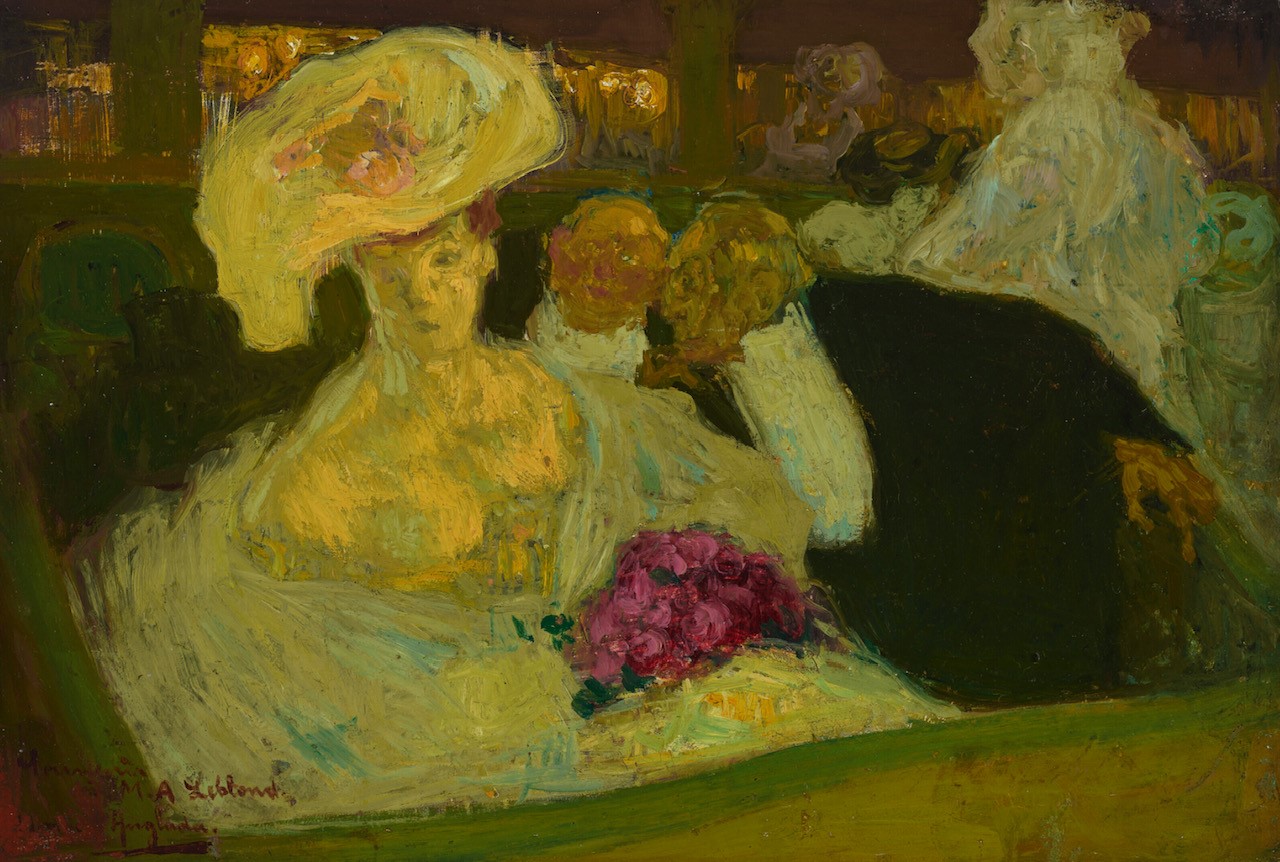
La Loge was painted by Hermen Anglada Camarasa during his stay in Paris in the first decade of the 20th century. There, he often depicted the city of the Belle Époque and its nocturnal scenes, illuminated by the recently introduced electric lighting, which revealed the chlorotic faces of its residents.
La Loge is dedicated to Marius-Ary Leblond — a pseudonym adopted by the writers and journalists Georges Athénas and Aimé Merlo. Under this shared name, the two cousins, originally from the island of Réunion, published their journalistic and art-critical writings. Discussing the works in which Anglada Camarasa portrayed the nightlife of Paris, they highlighted the connection between the feminine world and dance, suggesting the deceptive purity of a nocturnal femininity whose representation conveyed emotion through the rhythm of movement:
Beyond the hedonism and sensuality of Anglada’s paintings, these critics identified a choreographic paradigm in which aesthetics and sensation are rooted in bodily movement, whose dance continually reinvents form.
The article that Marius-Ary Leblond devoted to Anglada in 1901 may well explain the dedication inscribed on La Loge, as both article and painting are close in dating and subject matter.
“Dance is the essential rhythm of amorous life, and Anglada has captured, with immediacy and force, the synthetic phases and the representative forms of emotion and the associations of life. Even in the act of walking he has spotted the penetrating, secret and gentle rhythm of dance.”
Marius-Ary Leblond, “Hermenegildo Anglada,” in La Grande France, Paris–Algiers, July 1901.