

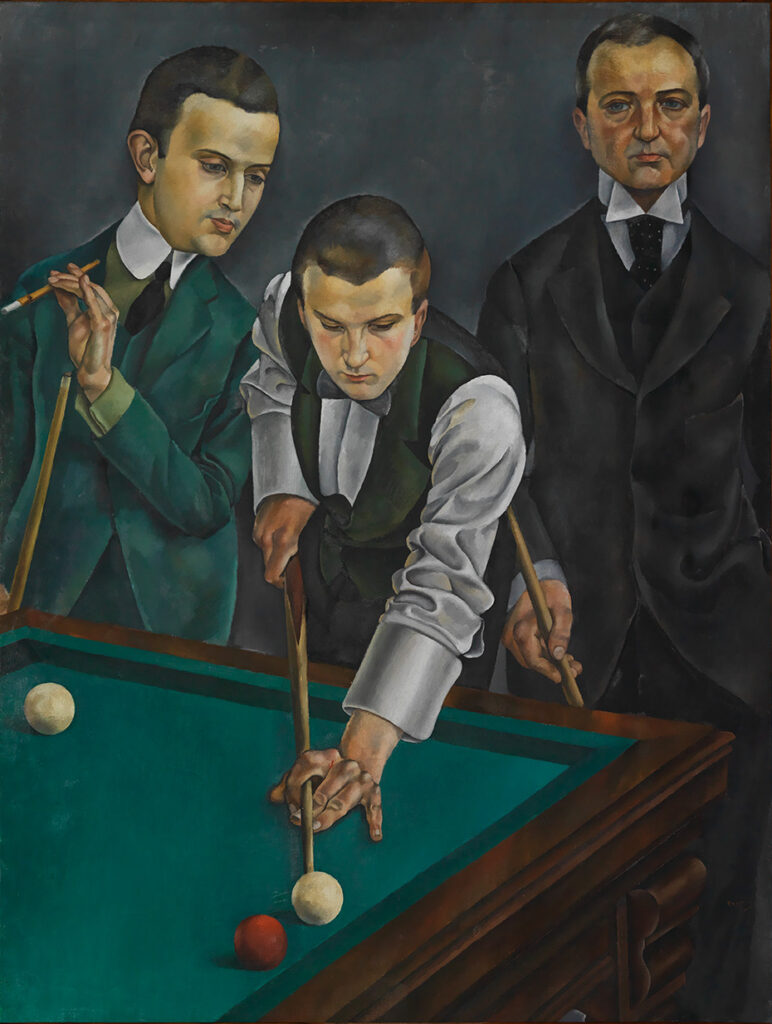
The great success José de Togores enjoyed in his lifetime can be explained through Billiard Players. In 1919, the artist settled in Paris for an extended period, where he combined his artistic practice with work as an art critic. Having already found an important source of inspiration in the work of Paul Cézanne, Togores encountered the European avant-garde and the circle of the poet Max Jacob. This environment brought him into contact with Galerie Simon and its owner, the influential dealer Daniel-Henry Kahnweiler, who represented him in France from 1921 to 1931, while Alfred Flechtheim exhibited his work in Germany. The support of these leading figures gave Togores greater confidence in his artistic direction and encouraged a more experimental approach. During this time he produced some of the finest works of his career, engaging directly with avant-garde movements. Between 1928 and 1931, starting from a figurative style closely aligned with the German Neue Sachlichkeit (New Objectivity), he created a series of paintings informed by the surrealist principle of psychic automatism.
In 1932, Togores returned to a more classical form of figurative painting. After settling once again in Catalonia, he developed a realist style, much more traditional, which he never abandoned before his death in 1970, following a traffic accident.
After the Spanish Civil War, Togores returned to Barcelona, marking the definitive end of his engagement with modernity. Because most of his early paintings had been exhibited and sold elsewhere in Europe, they remained largely unknown in Spain. As a result, his reputation was shaped primarily by his later production: a realist body of work, far removed from the international avant-garde, that secured his popularity among the Catalan bourgeoisie.
Billiard Players was painted in 1920, the same year in which Togores portrayed his cousin Alejo, who also appears as one of the billiard players in this composition. In both paintings, the artist succeeds in conveying the psychological depth of the sitters. Their detached gazes and unsettling yet expressive gestures are in stark contrast to the synthetic forms of the composition. Together with the portrait of his cousin Alejo, Billiard Players is considered one of the masterpieces of the artist’s Magic Realist period.